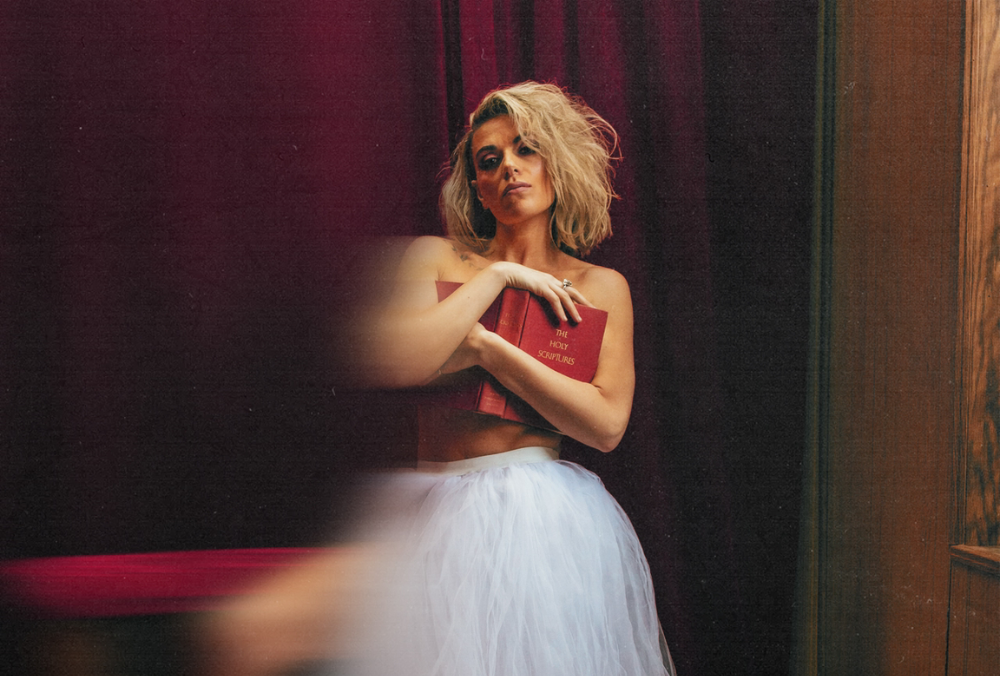
Jen Ash: “Whatever You Choose for Your Life Is Valid”
Some artists make music to be liked. Jen Ash makes music to give people permission to choose differently — and she means it without judgment. From “Hell,” a direct confrontation with religious hypocrisy, to her latest release “Woman,” a meditation on identity, freedom, and the quiet cost of following a path that was never yours, Ash has positioned herself as an artist with a mission: give voice to the ones society would rather keep quiet. Not to fight. Not to divide. But to say — whatever you choose, it’s valid.
“Woman” arrives as both a polished single and a stripped-back rehearsal video — two versions of the same truth, delivered at different volumes. The song challenges the narrative society writes for women before they’re old enough to push back against it, while holding space for every woman on every side of that choice. In this conversation, Jen Ash breaks down the lyric that will hit differently depending on who’s listening, why the song sat unreleased for a year, and what’s coming next — including “Freedom,” a track confronting forced marriage and the silencing of women that, in 2026, is still not history.
Your latest release “Woman” follows a clear narrative arc—from confronting external pressure to arriving at self-determined peace. At what point in writing “Woman” did you know the ending had to land on resolution rather than defiance?
I’m a strong believer in the freedom of choice. Whatever you decide to do with your life, if you’re at peace with it, I respect it. The only line for me is this: don’t force your path onto others or judge them for choosing differently.
Too many people believe their way is the way, and that mindset is exactly what inspired me to write “Woman.” We’re all different, yet society continues to praise traditional paths while diminishing those who dare to choose something else.
I wanted to honor the rebels—the ones who challenge what we call “normal.” I’m not here to judge anyone, but to give a voice to those who make unconventional choices.
This song is about freedom of choice, and the judgment that often comes with deciding not to follow the path society expects from women. I want people to feel at peace with their decisions.
I know the message may trigger some and create resistance, but I’m not here to fight. I’m here to say: whatever you choose for your life is valid. Let go of the judgment, because your path matters.
“There’ll be no child to take your shine away” is a line that will hit differently depending on who’s listening. How do you want women who have chosen motherhood to receive this song?
I thought about that line for a long time.”there’ll be no child to take your shine away”
At first, I felt like it might be too harsh.
I have so much respect for mothers—truly. But I also recognize the sacrifices they make. Their children become the priority, and many women put their own dreams on hold to raise them.
I want them to know: I see you.
I’ve had honest conversations with several of my friends who became mothers, and there are truths that aren’t talked about enough—the pain, the sacrifices, the sleepless nights, the mental breakdowns. We rarely speak about it, because having children is supposed to be the most beautiful thing in the world.
But sometimes, it comes with a cost.
The self-care you once had, the shine you carried before becoming a mother—so much of it gets poured into raising your child. And I see that. I honor that.
I’m grateful to the mothers who have shared their truth with me so openly. Their honesty gave me a real perspective—one that made me realize: maybe motherhood isn’t for me. And that’s okay.
The stripped-back rehearsal—just guitar and vocals—removes every layer of production. What did performing “Woman” that way reveal to you about the song that the full production didn’t?
I love performing with just guitar and vocals because the message becomes crystal clear—you can’t hide your words behind instruments. That’s why I choose my lyrics very carefully, especially since English isn’t my first language. I treat every line as if it truly matters, aiming to make an impact with each phrase.
The stripped-down sound pulls you into the story. It creates an intimate space where nothing can be masked. You’re fully present with the emotion.
I love performing with a full band too—the energy, the adrenaline, the fun—but sometimes people need something deeper, a more personal connection to the story.
When I dive into my lyrics, I get incredibly emotional. My challenge is to express those feelings and share them authentically without breaking down into tears.
I think finding a balance between stripped-back moments and full-band energy is powerful. It brings variety to the songs and lets each one connect in a different way.
You described the song as “owning your truth in its purest form.” Was there any hesitation in releasing something that exposed, or did the vulnerability feel necessary for this particular message?
The song was ready last year, but I was never fully satisfied with it. I kept finding reasons—excuses, really—not to release it. Looking back, I think I just wasn’t ready on a subconscious level, so I avoided it.
When I released “Hell,” my previous song about the hypocrisy of religion and the conditioning around Heaven and Hell, I took a bold risk. I had to ask myself: do I just want to be a singer, or do I want to be a voice for others?
The backlash I received was actually a sign. It meant I was touching something real—something that challenges people. And that’s when I knew I was doing something right. I don’t need to be liked by everyone. I want to push people out of their comfort zones and remind them not to be afraid to live unapologetically as who they truly are.
I take my role as an artist very seriously, and that comes with responsibility. “Hell” and “Woman” are just the beginning of the journey. I’m here to make the world a better place, and that means embracing vulnerability, letting go of the fear of backlash, and staying true to myself and to others.
Do you see yourself doing more stripped-back releases, or was this a one-time companion piece?
I’m planning to release stripped-back versions of some of my songs, and sometimes I love them even more than the originals. There’s something about that rawness that really speaks to me.
I don’t want to hide. Some artists create a persona, I just want to be myself and share that with people. To connect, to exchange, to be of value—that’s my true mission and purpose.
You’ve drawn comparisons to Madonna‘s presence and Shakira‘s intensity. Which artists — outside of those references — do you think have influenced how you deliver a message, not just how you sound?
Céline Dion truly mastered that. The storytelling in her French songs is remarkable—they make you feel something deeply. It’s never just a song; it’s a story you can step into, something you can relate to on such a personal level that it feels like it was written just for you. That’s the kind of emotional connection I want to create with my music. At the end of the day, people don’t just remember melodies—they remember how you made them feel.
The golden era of Chanson Française taught me so much about songwriting, even back when I was fully focused on my basketball career. That tradition is rooted in emotion, storytelling, and truth. Artists like Lara Fabian, Jean-Jacques Goldman, and Patrick Bruel are true storytellers—artists who don’t just perform songs, but bring entire emotional worlds to life through their music.
“Woman” addresses societal pressure on women around motherhood and identity. Is the next single continuing that thematic thread, or are you pivoting to a different subject entirely?
On the thematic thread I’m currently exploring, “Freedom,” the song sheds light on forced marriage and the abuse of women. It’s hard to believe that in 2026, this is still happening. So many women remain silent—held back by fear, shame, and pressure.
The oppression of women is still very real, and in some parts of the world, even child marriage is still permitted. That reality deeply enrages me, and it’s exactly why I feel the need to speak on it.
This song is my way of using my voice to bring awareness, to stand with those who feel unheard, and to challenge a system that continues to allow this. The oppression has to end.
With both a polished single and a raw rehearsal video out, how are you thinking about visual storytelling for the rest of the year — more performance-driven, more conceptual, or a mix?
I believe in a mix of everything. When I create visuals, they usually come to me naturally, I don’t force anything. It’s very instinctive. Right now, we’re working on stripped-back videos for “Woman,” “Freedom,” “Do You Ever,” and a future song called “Outside Looking In.”
I’m also definitely planning a music video for “Freedom.” I already have a few visual concepts in mind, but it’s still in the early stages. I want to make sure it does justice to the message and carries the weight it deserves.
To balance the heavier themes of “Hell,” “Woman,” and “Freedom,” I’m releasing “Back to the Beat”—a lighter, more uplifting track. It’s about hope, about returning to music when life lets you down. Going back to the beat and letting it heal your soul. Music frequencies have a real power—they can shift your mood, ground you, and bring you back to yourself.
This will also be the first time in a while that I’ve collaborated with another writer, Robby Robb Lewis, and I’m excited to see how people respond to it. It’s such a fun, feel-good track—and the music video is already ready to go. Now it’s just a matter of timing the release.